)
DOCOMO is now developing and deploying container-based VNF as vRAN and 5GC. This activity evolves operational way significantly by cloud-native technology and the evolution extends NFV merits. The fundamental benefits of NFV are economic cost, telecom level quality and automation operation. Minimizing cost, power, and on-site maintenance is important for cost reduction and extending RAN domain will get more merit. Intelligent, autonomous and highly efficient resource management are also important for automation and quality such as long term and stable NFV platform and end to end orchestration.
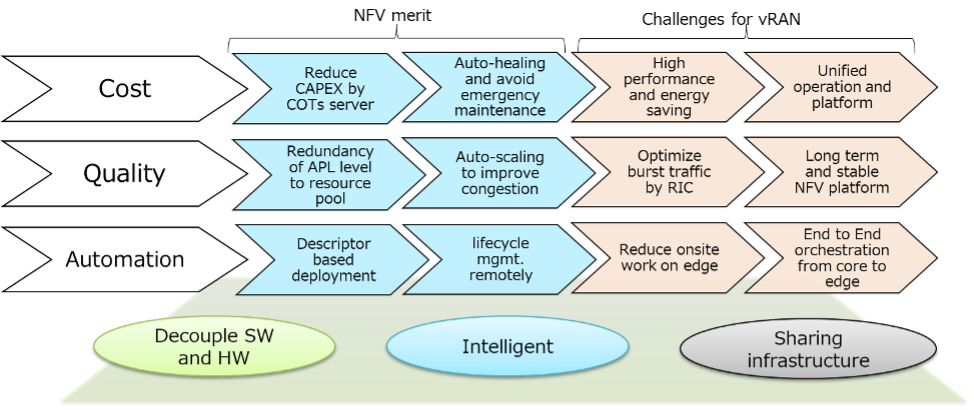
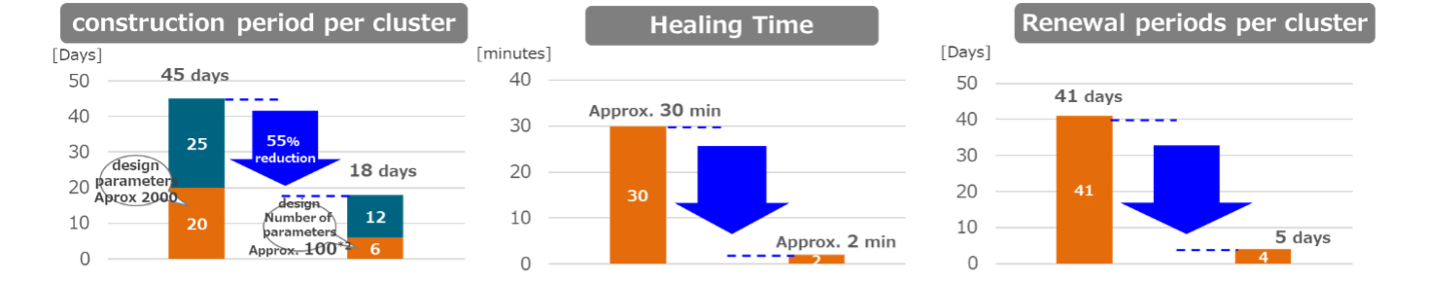
New technology of container also enhances more NFV merits. Construction time, healing time and renewal periods have been shorten significantly.
2. Next steps
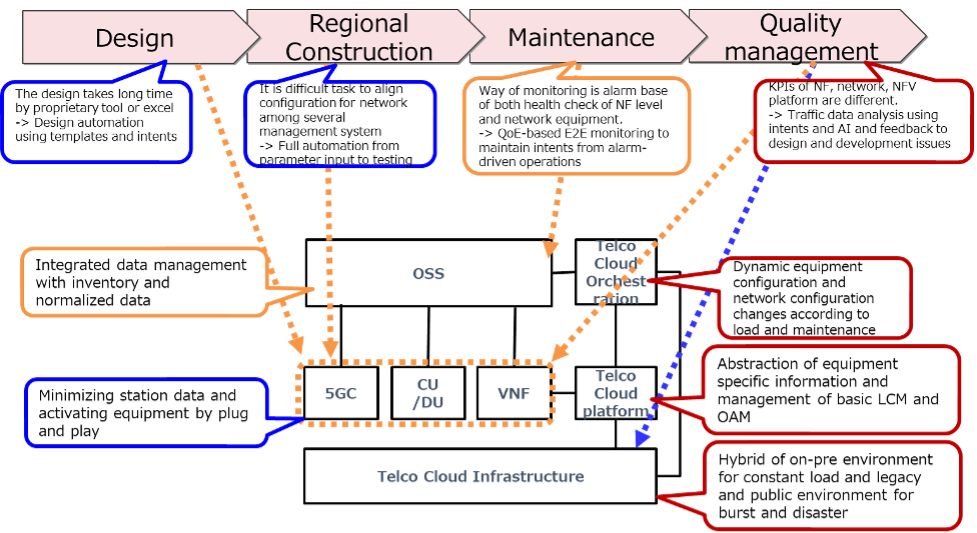
The next step of DOCOMO is evolution of platform with new operational way for more dynamically and dramatically. Although original concept of DOCOMO NFV is to keep maintenance way as legacy operation, DOCOMO is trying to evolve its operational way more dynamic topology of cloud-native, unified data lake and AI technology as figure 10. Operator has 4 big items for operations, design, construction, maintenance and quality management.
- Operator wants to shorten design periods by intent or template base deployment.
- Construction still requires many manual operation, such as configuration among different system, testing, so full automation from parameter input to testing is necessary.
- Current maintenance work is alarm driven approach that detects and repairs failure triggered by alarm, but QoE-based End to End monitoring to maintain intent is important for user experience.
- Quality management is difficult and analyze KPI for long term due to different KPIs, but realtime analysis to detect sign of failure by AI is necessary
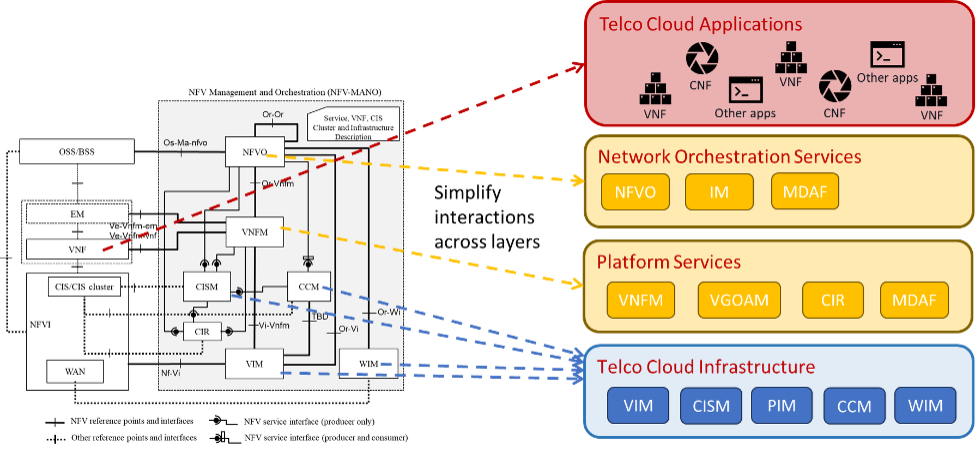
In order to new steps, evolution of NFV to Telco Cloud is important. DOCOMO will contribute Telco Cloud architecture and align among standards and open source.
3. Tacker activity
Tacker team and DOCOMO are also discussing migrating to a Telco Cloud architecture while incorporating new requirements like those mentioned above to keep pace with the evolution of NFV standards.
Current Tacker implementations, like other OpenStack projects, achieve complex NFV specifications by modularizing functionality and ensuring extensibility. However, many key functions—such as lifecycle management and fault recovery—are concentrated within the VNF Manager. Telco Cloud, on the other hand, aims to cover a broader range of use cases, e.g. various type of applications, and enable a smooth transition to 6G by modularizing these functions into separate components and combining them appropriately to meet necessary requirements. The new design of Tacker will be finalized going forward, taking into account the maintenance of the current implementation and the migration timeline, while keeping an eye on the ETSI NFV standard discussions.

- Ongoing Development and Next Steps for DOCOMO and Tacker - April 7, 2026
- NTT DOCOMO’s Tacker Activity - February 3, 2026
- NTT DOCOMO’s Journey of Virtualization for Mobile Networks - January 14, 2026